
Quick Answer
A Devil Fruit (Akuma no Mi, 悪魔の実) is a mysterious fruit from Eiichiro Oda’s One Piece universe that grants whoever eats it a permanent supernatural power, in exchange for permanently losing the ability to swim. There are three categories: Paramecia (body or matter modification), Zoan (animal transformation) and Logia (body becomes a natural element — the rarest). More than 200 fruits have been named in the manga.
Article written by the Wanted Store team — sources: One Piece manga vols. 1–110+ by Eiichiro Oda, Toei Animation anime, official SBS. Updated on April 26, 2026 (post-Egghead).
What Is a Devil Fruit in One Piece?
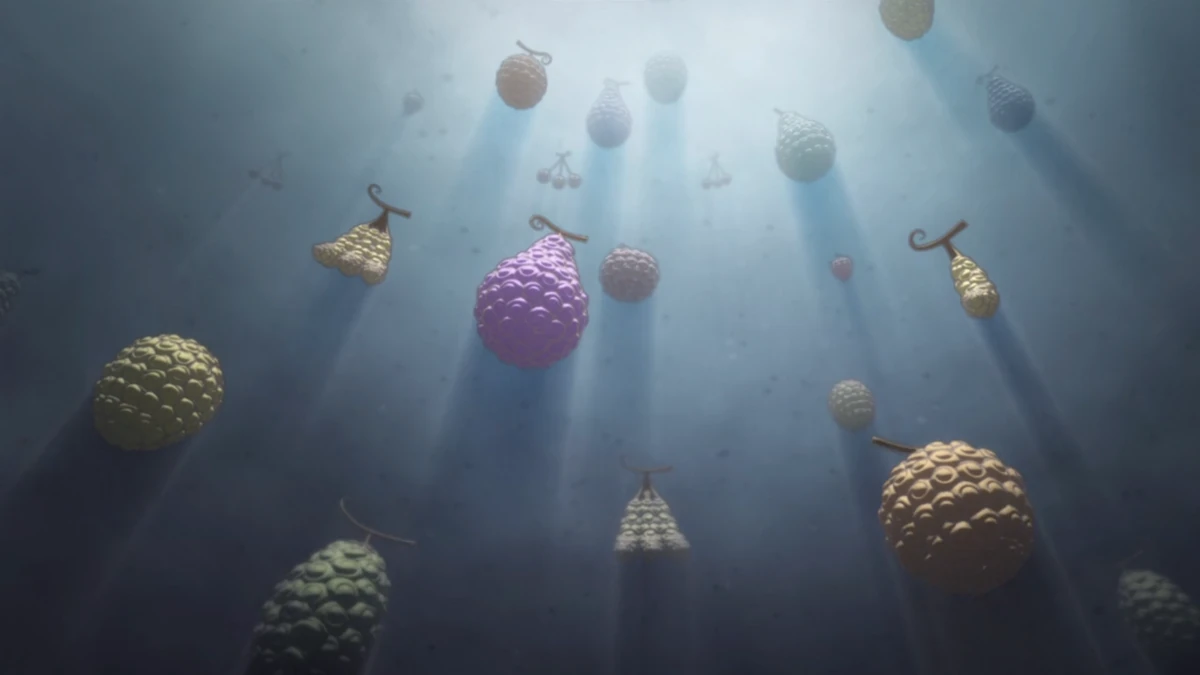
A Devil Fruit is an ancient fruit that bestows a unique supernatural power upon whoever takes even a single bite. Once eaten, the fruit loses all its properties; the power remains bound to its user until death. At that precise moment, the fruit « revives » in a normal form — identifiable by its distinctive spiral patterns — and reappears somewhere in the world, ready to be consumed by a new bearer. This is how Sabo inherited the Mera Mera no Mi from Portgas D. Ace after the War of Marineford. The trade-off is universal: users become incapable of swimming and are paralysed upon prolonged contact with seawater.
The 3 Devil Fruit Categories: Comparison Table
| Criterion | Paramecia | Zoan | Logia |
|---|---|---|---|
| Effect | Modifies the body or surrounding matter | Animal transformation (3 forms) | Body becomes a natural element |
| Rarity | Very common (~70%) | Average (~25%) | Very rare (~5%) |
| Intangibility | No | No | Yes (without Haki or elemental weakness) |
| Sub-types | None | Standard, Ancient, Mythical | None |
| Iconic example | Gomu Gomu (Luffy) | Uo Uo Seiryu (Kaido) | Yami Yami (Blackbeard) |
| Universal weakness | Seawater + Seastone | Seawater + Seastone | Seawater + Seastone + Haki |
Paramecia — the Broadest Category
Paramecia fruits account for the majority of named Devil Fruits to date. They modify the user’s body or allow them to alter the surrounding matter. Iconic examples:
- Gomu Gomu no Mi (elasticity) — wielded by Monkey D. Luffy, revealed to actually be the Hito Hito no Mi, Model: Nika, classified as a Mythical Zoan by the World Government.
- Bara Bara no Mi (split) — Buggy the Clown, capable of splitting his body into independent parts.
- Hana Hana no Mi (flower) — Nico Robin, sprouts her limbs anywhere.
- Ito Ito no Mi (string) — Donquixote Doflamingo, controls objects and people via invisible strings.
- Ope Ope no Mi (operation) — Trafalgar Law, considered the ultimate fruit by the underworld for its immortality technique.
- Gura Gura no Mi (tremor) — Edward Newgate (Whitebeard), described as “capable of destroying the world.”
Zoan — Animal Transformations
Zoan fruits grant animal transformation with three forms: human, animal, and hybrid. They come in three sub-categories of increasing rarity:
- Standard Zoan — contemporary animals (Chopper’s Hito Hito no Mi, which transformed a reindeer into a human).
- Ancient Zoan — prehistoric animals (X Drake as an Allosaurus, Page One as a Spinosaurus, Queen as a Brachiosaurus).
- Mythical Zoan — legendary creatures, extremely rare (roughly one fruit per century):
- Tori Tori no Mi, Model: Phoenix — Marco the Phoenix, regenerative blue flames.
- Uo Uo no Mi, Model: Seiryu — Kaido, eastern blue dragon.
- Hito Hito no Mi, Model: Daibutsu — Sengoku, giant golden Buddha.
- Inu Inu no Mi, Model: Okuchi no Makami — Yamato, divine wolf of Wano.
- Hito Hito no Mi, Model: Nika — Luffy, the sun god of liberation (revealed at Wano, chapter 1044).
Logia — Body Becomes a Natural Element
Logia fruits are the rarest and most feared category. The user transforms their body into a natural element, becoming intangible against standard attacks. To harm them, one needs Armament Haki, Seastone (kairoseki), or an elemental counter:
- Mera Mera no Mi (fire) — Portgas D. Ace, inherited by Sabo.
- Magu Magu no Mi (magma) — Akainu, elementally superior to fire.
- Goro Goro no Mi (lightning) — Enel, considered “invincible” by Oda himself.
- Pika Pika no Mi (light) — Kizaru, moves at the speed of light.
- Hie Hie no Mi (ice) — Aokiji, freezes entire oceans in seconds.
- Suna Suna no Mi (sand) — Crocodile, desiccation.
- Yami Yami no Mi (darkness) — Blackbeard, the only non-intangible Logia, capable of nullifying other fruits on contact.
What Is Devil Fruit Awakening?
Awakening is an advanced threshold that allows the user to extend their fruit’s properties beyond their own body — typically to the surrounding environment and matter. Reaching this state requires years of intensive training and has only been achieved by a handful of characters in the series.
Confirmed Awakenings to date:
- Donquixote Doflamingo (Ito Ito) — transforms buildings and floors into strings.
- Charlotte Katakuri (Mochi Mochi) — transforms the environment into mochi.
- Luffy in Gear 5 (Hito Hito no Mi, Model: Nika) — manipulates matter like cartoon rubber, animates objects.
- Nico Robin (Hana Hana, Demonio Fleur) — summons a demonic giantess.
- Jewelry Bonney (Toshi Toshi) — projects a “Distorted Future,” an imagined future version of herself.
- Kaido, Big Mom, Marco, Rob Lucci, Kid — Awakenings confirmed or strongly implied.
For Zoan fruits, Awakening enhances regeneration and physical strength without transforming the environment.
Blackbeard’s Unique Case: Why 2 Devil Fruits?
Every user is supposed to be able to eat only one Devil Fruit — a second one would cause the body to explode fatally. Yet Marshall D. Teach (Blackbeard) is the only pirate in the world to carry two fruits simultaneously:
- Yami Yami no Mi (darkness, Logia) — absorption ability.
- Gura Gura no Mi (tremor, Paramecia) — taken from Whitebeard’s corpse at Marineford.
The exact mechanism remains one of the series’ greatest mysteries. Several theories circulate: an abnormal body structure (mention of « three souls » in the SBS of volume 56), the Yami Yami’s absorption power, or surgical intervention. None has been confirmed by Oda to date.
What Is the Origin of Devil Fruits?
The exact origin remains one of One Piece’s greatest mysteries. Numerous clues have been seeded across arcs, notably through Dr Vegapunk’s research:
- Energy of the sea — Vegapunk states that Devil Fruits are the incarnation of human dreams and that the sea rejects them as anomalies of nature.
- Distinctive spiral patterns — every fruit, regardless of its appearance, features unique spiral markings.
- SMILE — artificial fruits created by Caesar Clown and Doflamingo, attempting to replicate Zoans. Failure rate: 90% (the “failures” lose their emotions and can only laugh).
- Hito Hito no Mi, Model: Nika — hidden by the World Government for 800 years, proving that the Five Elders have known of the existence and threat of certain fruits since the Void Century.
FAQ — Everything You Want to Know About Devil Fruits
What Is the Most Powerful Devil Fruit in One Piece?
Officially, Whitebeard’s Gura Gura no Mi was described by Sengoku himself as “capable of destroying the world.” In practice, several contenders for the title of strongest fruit coexist: Luffy’s Hito Hito no Mi, Model: Nika (rewrites reality in Gear 5), the Ope Ope no Mi (capable of granting immortality to another at the cost of the user’s life), the Yami Yami no Mi (nullifies other fruits), and the Goro Goro no Mi, which Oda called “invincible.”
Why Can’t Devil Fruit Users Swim?
According to Vegapunk, the Devil Fruit is hated by the sea. The user loses all ability to swim and remains paralysed whenever their body is submerged. Seastone (kairoseki) emits the same energy as the sea and is used by the Marines to neutralise captured pirates.
Can a Devil Fruit Be Passed On to Someone Else?
Yes, but only upon the user’s death. The power leaves the body and an identical fruit reappears somewhere in the world, ready to eat. This is how Sabo inherited the Mera Mera no Mi from Ace during the Dressrosa Tournament.
How Many Devil Fruits Exist in One Piece?
More than 200 fruits have been named or shown in the manga (chapters 1 to 1130+). Vegapunk mentions the existence of hundreds of fruits scattered across the world, with no exact confirmed number. Artificial SMILE fruits push that total above 300 if included.
What Is the Difference Between Logia and Zoan?
A Logia transforms the body into a natural element (fire, ice, lightning) and grants intangibility. A Zoan transforms into an animal (standard, ancient, or mythical) and grants superior regeneration and amplified physical strength. A Zoan user remains tangible but hits harder than an un-Awakened Paramecia or Logia.
Is the Gomu Gomu no Mi Really a Paramecia?
No — a major revelation in the Wano arc (chapter 1044). Luffy’s fruit is actually the Hito Hito no Mi, Model: Nika, a Mythical Zoan representing the “sun god of liberation.” The World Government had renamed it “Gomu Gomu” to conceal its existence for 800 years, since the Void Century.
What Is the Highest Bounty Among Devil Fruit Users?
As of today (post-Egghead 2026), Monkey D. Luffy holds the highest active bounty among Devil Fruit users at 3 billion Berries, followed by Marshall D. Teach (Blackbeard) and Buggy at Yonko level. Discover the official Wanted Posters of each user.
Is There a Fruit That Can Resurrect the Dead?
Yes: Brook’s Yomi Yomi no Mi (Paramecia). It allowed his soul to return to his body after death. It is a unique case in the series, which reappears in theories about Pluton and resurrection.
Further Reading
- Top 10 Epic Battles in One Piece — Marineford, Wano, Onigashima.
- Theories About Luffy’s Past — Joy Boy, Will of D, Nika.
- All One Piece Wanted Posters — 57 models available.